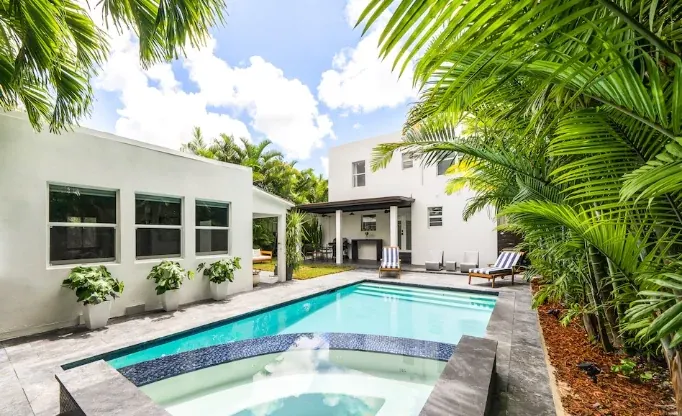
Shenandoah was platted in 1919 by developers from Virginia and built out through the 1920s land boom — Mediterranean Revival houses, Mission-style bungalows, and a handful of two-family structures scattered through the same blocks. Nearly all of that housing stock predates the zoning code governing it today. That gap between when a house was built and when the current rules were written is exactly where the confusion about "legal duplexes" comes from, and it's worth understanding before it shows up as a surprise during financing, insurance, or a renovation permit.
The three flavors of T3
Most of Shenandoah sits within the T3 Sub-Urban zone under Miami 21, the city's zoning code. T3 splits into three sub-designations that look similar on a map but allow very different things:
- T3-R (Restricted) — single-family residential only.
- T3-L (Limited) — single-family, plus an ancillary unit (a "granny flat" on the same lot).
- T3-O (Open) — single-family and two-family (duplex) residential.
Only T3-O permits a duplex as of right. A house sitting on a T3-R or T3-L lot cannot legally operate as a two-family property today, regardless of how it was originally built or how it's currently configured — full stop, that's the zoning code, not a matter of interpretation.
Why a 1920s house can still be a legal duplex
Here's the nuance that actually matters for a neighborhood this old. A property's current two-family use can be legal in one of two very different ways, and the difference has real consequences:
Legal, conforming duplex. The parcel is zoned T3-O, so a two-family structure on it complies with today's code outright. No special status needed — it's simply an allowed use on that lot.
Legal, nonconforming duplex. The house was built or converted to two units before the zoning changed, and the lot is now zoned T3-R or T3-L, which no longer permits that use. Miami 21 generally lets a use like this continue — it's "grandfathered" — but nonconforming status carries real limits: the use typically can't be expanded, and if the structure is destroyed beyond a set damage threshold, rebuilding it as a duplex is not assured under current rules. A conforming duplex on a T3-O lot doesn't carry those constraints; a nonconforming one does.
There's a third category worth naming precisely because it's the costliest to discover late: a two-family conversion that was never permitted at all. This shows up more often than buyers expect in a neighborhood built a century ago, long before enforcement and permitting records were what they are today. An unpermitted second unit isn't a legal use of any kind, and it creates real friction with lenders, insurers, and appraisers — even if the rent has been collected without incident for years.
What this means before you make an offer
Zoning designation isn't visible from the street, and it isn't something the seller's listing description settles on its own. Before assuming a Shenandoah property carries duplex rights — whether you're buying it for that reason or evaluating one that already has a second unit — I'd verify three things:
- The parcel's current zoning designation, via the City of Miami's zoning map/GIS.
- Whether the two-family use is permitted, by pulling the property's permit history — this is what separates a legal conforming or legal nonconforming duplex from an unpermitted conversion.
- A zoning verification letter from Miami's Planning & Zoning Department, where the stakes justify it (financing a purchase around rental income, or a renovation that touches the second unit). It costs a small fee and settles the question in writing rather than by assumption.
For anything that turns on a legal determination — whether nonconforming rights survive a specific renovation, or whether a structure qualifies for rebuild after damage — that's a question for a real estate attorney, not a listing description. I'll flag what I see in a property's zoning and permit history, but I don't make that call myself, and neither should a buyer relying on secondhand information from a prior listing.
The practical upside, stated plainly
Where a legal duplex genuinely exists — conforming or grandfathered — it changes the ownership math for a buyer: a second income stream, a setup for multi-generational living, or flexibility that a strict single-family lot doesn't offer. That's a real and valuable feature when it's verified. It's just not something to assume from a home's age, its layout, or the fact that it currently has two kitchens.
FAQ
Is Shenandoah, Miami zoned for duplexes?
Parts of it. Shenandoah's zoning is a mix of T3-R, T3-L, and T3-O under Miami 21 — only T3-O permits a two-family duplex. It varies parcel by parcel, so it has to be checked per property rather than assumed for the neighborhood as a whole.
What is T3-O zoning?
The "Open" designation within Miami 21's T3 Sub-Urban zone. It's the only T3 sub-zone that allows a two-family (duplex) residence in addition to single-family use.
Can I convert a single-family Shenandoah home into a duplex?
Only where the underlying zoning allows it — meaning the parcel would need to carry a T3-O designation, and any conversion would need to go through the City of Miami's permitting process. This is a zoning and permitting question best confirmed directly with the Planning & Zoning Department, or with a real estate attorney, before relying on it.
What's the difference between a legal and a "legal nonconforming" duplex?
A legal duplex sits on a lot zoned to allow it today (T3-O). A legal nonconforming duplex predates the current zoning and is allowed to continue under grandfathered status, but with real restrictions on expansion and rebuilding after major damage. Both are different from an unpermitted conversion, which isn't a legal use at all.
This article describes Miami 21 zoning categories generally and is not a zoning determination for any specific parcel. Verify a property's exact zoning and permit history with the City of Miami Planning & Zoning Department, and consult a real estate attorney for any legal-use determination. Compiled by Gatien Salaun, Coldwell Banker Realty.