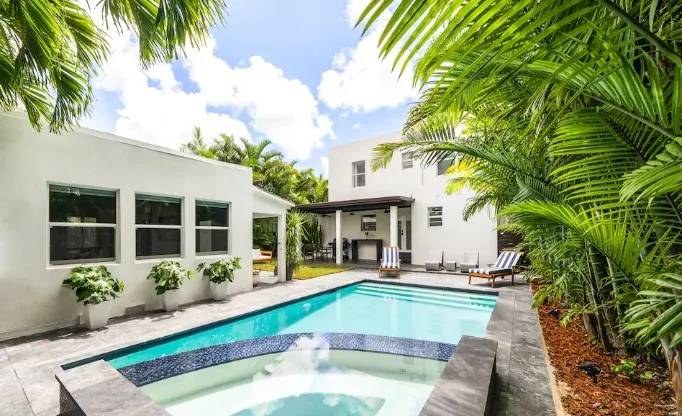
Most of what I write about Shenandoah is data — closings, days on market, price bands. This one is a single deal, walked through in enough detail to show what the data doesn't capture: how one overlooked fact in a listing changed the entire economics of a purchase, and what happened over the next two years because of it.
The listing
In September 2022, I was working with a buyer looking in Shenandoah — a Mediterranean-style home with a detached guest house on the lot. The listing described it as zoned single-family, which is how most buyers, and most agents, would have read it and moved on.
I didn't move on. Shenandoah's zoning is a patchwork left over from a neighborhood platted in 1919 and built out through the 1920s, long before the zoning code governing it today existed — the same T3-R/T3-L/T3-O layering I've written about separately on this site. A "single-family" label on an old Shenandoah listing is worth checking, not assuming. I checked, and found the property was actually zoned for two-family use — and the guest house on the lot already carried its own address on the parcel.
What that changed
That single fact turned a straightforward single-family purchase into something with real, verified upside: my client could renovate the main house with minimal structural work, add a pool, and separately renovate the guest house into legitimate second-unit value — not a hoped-for possibility, but a use the zoning already permitted. I walked him through what that could look like post-renovation before he wrote an offer, so the decision was made with the full picture, not half of it.
On the numbers side, the timing mattered as much as the zoning. We were in a genuine lull in that quarter's Shenandoah activity, and the purchase closed at what turned out to be one of the lower per-square-foot prices the pocket had seen in some time — well under what recent comparable activity would have suggested. We also negotiated the furniture into the sale, which is a small detail on its own but consistent with negotiating every point available, not just the headline price.
What happened after closing
The relationship didn't end at the closing table. Over the following two years, I managed leasing on the property for my client, placing tenants three separate times. The most notable of those closed in April 2024 at $13,900 a month. I went back to the MLS closing data for the zip code afterward, rather than just take the number at face value, and confirmed it: the previous highest lease closing anywhere in that zip code over the prior months was $5,000 — meaning this one closed at nearly three times the prior high, not just for the block, for the whole zip.
In July 2024, the same client came back to buy a second property, this one on the South Shenandoah plat, for $870,000. He's since renovated it and operates it as a short-term rental.
The takeaway
None of this happened because of a lucky guess. It happened because a listing detail that most people would have taken at face value turned out to be checkable, and checking it changed what the purchase was actually worth. That's the argument for working with someone who tracks a specific neighborhood closely enough to know when something in a listing doesn't match the neighborhood's actual history — not a promise about what any other property will do, just what happened with this one.
FAQ
What was the zoning issue in this Shenandoah case study?
A 2022 listing described the property as zoned single-family. It was actually zoned for two-family use, with a detached guest house that already carried its own address on the parcel — a fact not stated in the listing.
How is the record lease amount verified?
The $13,900/month closing was checked against MLS closing data for the property's zip code; the previous highest lease closing in that zip code over the prior months was $5,000.
Is this a typical outcome for a Shenandoah purchase?
No — this is one specific transaction, described in detail because the zoning catch and the subsequent leasing outcome were unusually clear-cut. It's not a representation of what any other property in the neighborhood will do.
Details drawn from closed MLS records and my own transaction log; the client's name is withheld for privacy. The lease figure is independently verified against MLS closing data for the property's zip code. Compiled by Gatien Salaun, Coldwell Banker Realty.